
The barn is a work in progress which we started building in July 2020. We stop working on it during the winter months and are able to only give time to building in between our busy work schedules so progress has been rather slow!
When we bought Tiggins Meadow in 2008 there was already an old mobile home caravan on site which we thought we’d get rid of as it was an eye-sore. However, it proved incredibly useful as a tool store, a place to run for shelter when a rainstorm came and a place to make a cuppa and eat our sandwiches. But we battled with mice, it was freezing cold in winter and way too hot in summer, and it was not in the right location for Granny to do bird spotting out of the window. When our son Kit, an architect, suggested replacing the caravan with something ‘properly built’ we took him up on the idea ! He designed us a barn which could be built by us (we are not experienced at anything more than home DIY), using low cost and readily available materials which could easily be brought onto site (no big lorries wanted on Tiggins Lane) and which wouldn’t have a huge impact on the environment. It needed to be vermin proof, have good thermal mass, longevity, and provide space for storing our tools, boots, and other equipment; have space to sit and watch nature on cold/wet days, house a ‘proper’ compost toilet, have workshop space, and have somewhere we can wash hands, cups and plates and get a hot drink.

We used ground screw stilts as the foundation in order to minimise the impact on the ground, to raise the building out of the wet clay, and to provide habitat underneath for creatures.
The wood frame was designed so that we could build it at home in our garden in kit form which we then transported to Tiggins Meadow in one journey. It was erected using the help of friends and family. We could never have guessed when we planned this that a global pandemic would throw all our lives into disarray so spectacularly. But what the barn building project provided was something we could safely do and involve other people in so that it felt hugely valuable giving people a common and sociable purpose in such difficult times. It was easy to work in a properly socially distanced way, and we divided our marquee into a workshop and a rest area with plenty of breezy space !


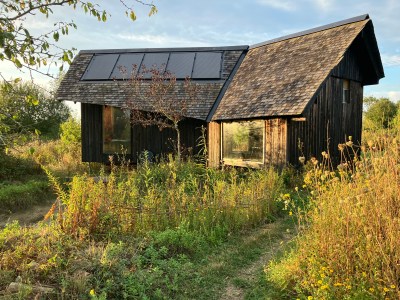
Part of the design is to use the ancient Japanese technique Shou Sugi Ban of charring the timber where it is exposed to the elements. This gives the timber resistance to weather, insects, UV sunlight and fire. We will be charring the cedar roof shingles and the weatherboards so that the barn will look like a traditional Suffolk black barn.


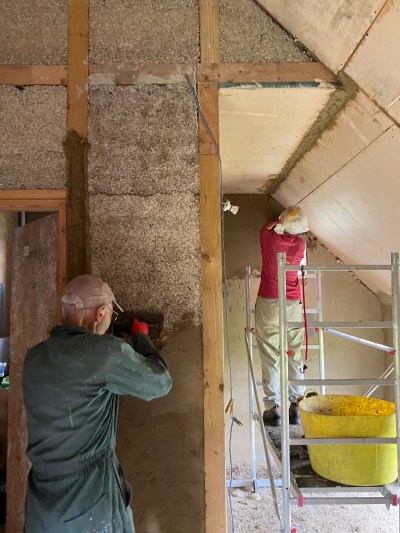
The walls were built using hempcrete made by mixing lime, water and hemp shiv. We were inspired to use this after reading lots about the use of hemp and visiting Margent Farm where Steve Barron showed us around. He says “Hemp is fast-growing and better than commercial forestry at sequestering carbon – and its long tap roots help to regenerate the soil. Beyond the relatively light processing and transportation emissions, the materials can be understood to be carbon-neutral (or carbon-negative if you count the sequestration), which is a vast improvement on steel, concrete, or petrol-based insulations.” (see link). We purchased the hemp from UK Hempcrete in Yorkshire. We chose to mix and place it by hand which is a slow process and we’ve learned a lot along the way !


We rendered the walls with a clay/sand/horse manure mixture using clay dug from the pond. It was full of bits of flint so it needed sieving before we could use it. We then gave it a final coat of limewash.
Next we started installing the cedar roof shingles, all of which needed charring first ! Luckily we had managed to get quite a lot done over the winter at home so that gave us a good quantity to start with.


While Ameer worked on the roof, Steve and Peter got the hempcrete floor laid. On one hard working day they achieved a record 7 mixes !!


Next we started on the south facing roof where shingles had to be fitted around the solar panel mounts. We also started rendering the interior walls.


It was very useful having climbers come to visit – they were very happy working up on the roof getting the solar panels installed. Gary also likes order in the workplace so built us a workbench and storage in the barn!


We chose to use UK-grown larch for our weatherboarding, which we were able to source from a Wiltshire supplier. This too needed charring so we tried various ways of doing this and ended up using a chimney method quite successfully.


We installed most of the roof insulation using a sheep’s wool product with breathable ceiling boards over.


By November 2021 we had got the two big windows installed with very able assistance from suppliers and installers Crown Glass. It’s great having natural light in the building to work by, and also it provides a lovely place to sit.


The pics below were taken in May 2022 when we had lots of help from Kit (the architect for the barn) and our youngest helper, two year old Otto:


August 2022 – Steve & Peter completed boarding the ceiling and worked out a way to seal the gaps between the boards using home made caulking. Steve created hemp rope from some hemp scrim we’d got, and then oiled it. The caulking is done before the plastering is started.


We had fun experimenting with internal plastering mixes using the clay dug from the pond outside the barn, mixed with horse manure and sand collected from a friend’s garden at Yoxford.


May 2023 – we got off to a slow start as the spring was cold and wet, but we managed to lay two of the three layers on the Earth Floor. It was really helpful having demonstrations and advice from professional Gemma Sayers.
Our barn has been used as examples by Vastern Timber (who supplied our larch cladding timber) in a case study, and Suffolk Owl Sanctuary in their blog about designing buildings for positive wildlife impacts.
With a cold, wet summer and other commitments we only made slow progress during the rest of 2023 although we did get the final large window pane installed:

And managed to start getting the earth floor laid using a mixture of clay dug up nearby as well as sand and chopped straw. We will need at least two layers on top of the hempcrete floor, possibly three with plenty of time to dry out in between. We got the first layer down in 2023 and started to do the final layer in 2024:
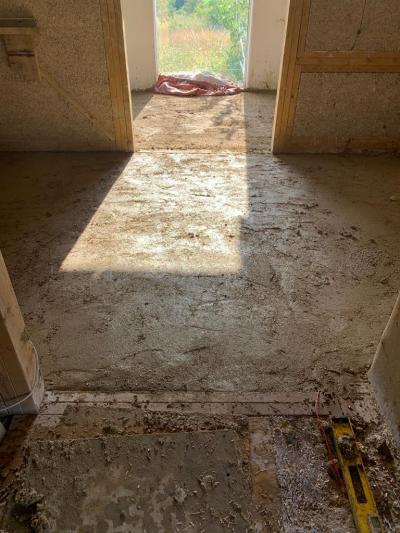
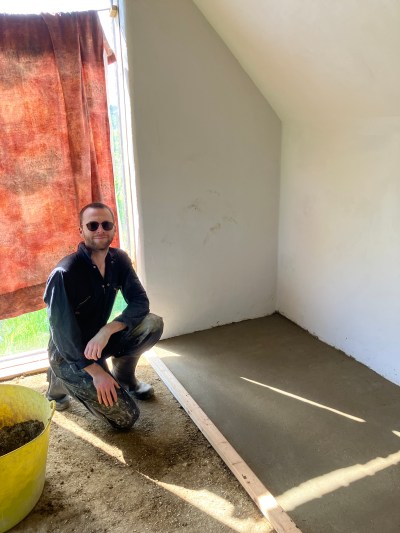

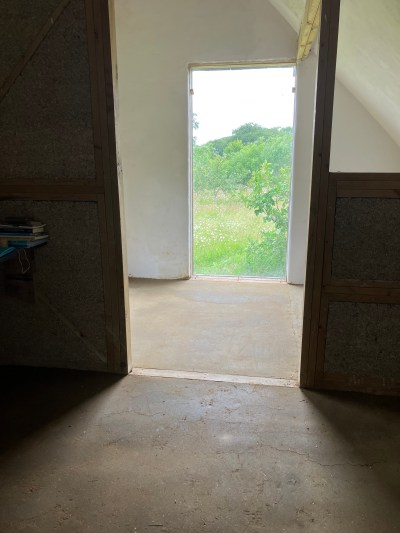
In 2024 we continued with the work of clay plastering on top of the hempcrete walls internally with valuable assistance from family and friends. It’s all rather experimental but that is the point!
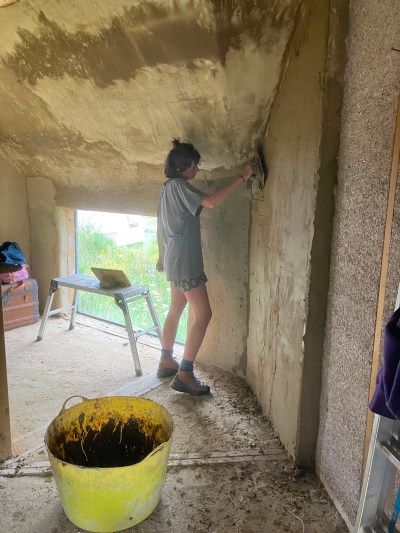
We still have plenty to do in 2025 – more work on the clay floor and clay plastering and lots more finishing off. But in the meantime the barn is successfully providing us with a secure and weather-proof place to keep tools, work clothes & boots and somewhere to run for shelter when it rains in the middle of harvesting willow !
 WILD ABOUT TIGGINS